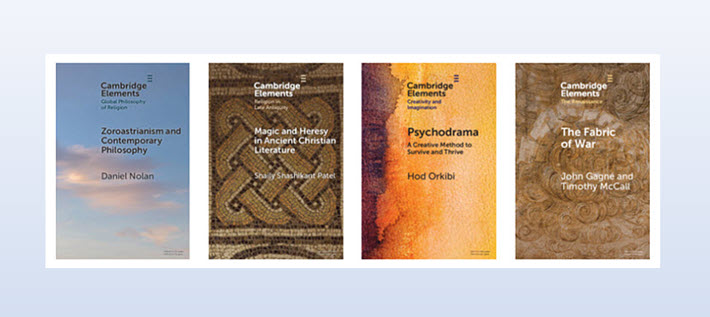

 Image: Cambridge Elements
By Porter Anderson, Editor-in-Chief | @Porter_Anderson
‘Interdisciplinary and Exploratory’
With more than 6.8 million downloads of various entries in the canon, the “Cambridge Elements” collection has reached its 2,000th short-form entry. The publisher likes to describe an “Element” as “a unique format in academic publishing between a book and a journal article, with a length of 20,000-30,000 words.” These are peer-reviewed short articles on a huge range of topics categorized into various series. (Note that all you see listed may not as yet be published; look for “forthcoming” where that’s the case for a series or an individual article. )
The program is housed on the Cambridge University Press site, which is branded “Cambridge Core.”
Many titles are evocative enough to draw in readers quite well (as those almost 7 million downloads would seem to attest). What you see on the Core site is an abstract of a given article.
As with any form of research, the pertinence of a given piece to what a user may be looking for will vary. And these pieces are aptly characterized by the company as “interdisciplinary and exploratory.” Whole series listed as forthcoming, for example, as of this writing, include “Elements in Comparative Political Behavior” and “Elements in AI Ethics and Society.”
However, it’s the general currency of so much of this growing overall collection that gives it punch. While there are many examples of “timeless” research into classical themes, of course, what may best match the short-read format of the Elements is what appears to be a speed-to-publication capability for current affairs.
 An example may be The Transformation of Protest Politics, found in the “Elements in Contentious Politics” series and written by Marco Giugni (University of Geneva) and Maria Grasso (Queen Mary University of London). This one carries an anticipated online publication date today (July 18). Available on pre-order when we checked, it was listed to be sold at $23 online for Adobe Ebook Reader; at $23 in paperback; and at $70 in hardback. The timings of the print editions are not those of the digital edition, too, so a user must be aware of this.
This suggests that as the next 2,000 articles are added to the program, some attention might well go toward bringing some coherence and consistency to publication formats and pricing.
For a private user, many of the Elements articles can be had for around US$22 each in digital editions. Some are available as Amazon Kindle ebooks for somewhat less, apparently, and some in paperback. There are hardcover editions of some Elements articles that are selling for more, naturally. And the rationale for these distinctions aren’t always immediately apparent and can differ from article to article. (Institutional purchase prices for individual Elements articles generally are considerably higher, of course.)
When looking into a series, using the “sorted by publication date” filter is a good idea for those interested in timing considerations.
‘Prime Motivations’
The Elements program was developed by Chris Harrison, Cambridge’s publishing director of HSS books, and Phil Meyler, publishing director of STM books.

 Chris Harrison
Harrison is quoted on the achievement of 2,000 Elements articles, saying, “When Phil and I pitched the idea for a new format that took advantage of the capabilities of our then new(ish) platform Cambridge Core—and that was midway between a journal article and a monograph—I don’t think either of us imagined we would be celebrating publication of the 2000th Element so soon.”
Meyler says, “One of the prime motivations in launching the Elements program was to provide a vehicle for types of academic work that wouldn’t otherwise find a published outlet.

 Phil Meyler
“I believe that we’ve succeeded in that aim, and seen an extraordinarily positive response from a broad spectrum of scholarly, technical, and clinical communities.
“The Elements program continues to be an excellent example of the importance of listening to, and responding to, the needs of our customers.”
 And—to the point of timeliness in this format—the 2,000th Elements article produced in the program is titled Elitism vs. Populism: Experiments on the Dual Threat to American Democracy, a piece by Curtis Bram of the University of Texas at Dallas.
This one is published online and listed as having a $22 price in paperback or ebook, $64.99 in hardback.
In the article’s description, we read, “This Element explores whether the trust that advocates of elitist democracy feel towards political elites is misplaced. In five experiments with local politicians, state legislators and members of the public, Bram identified a similar willingness across all groups to entrench their party’s power when given the opportunity—a self-serving majoritarianism transcending partisan lines.
“Bram also found that this tendency is strongest among committed ideologues, politicians running in highly competitive districts, and those who perceive opponents as especially threatening.”
It’s tempting to suggest we start placing bets on what the 4,000 Elements article will address.
More from Publishing Perspectives on Cambridge University Press is here, more from us on the British market is here, more on university presses is here, more on academic and scholarly publishing is here, more on open access is here, and more on digital publishing is here.