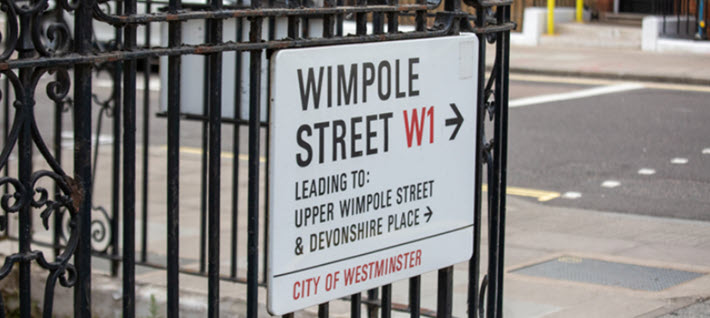

 London’s PLS 2025 conference on July 3 is at No. 1 Wimpole Street. Image – Getty: Byliam
By Porter Anderson, Editor-in-Chief | @Porter_Anderson
A CMO’s Take on Industry Issues
As the spring season of international publishing events continues past June, the Publishers’ Licensing Services (PLS) in London has announced programming information about its July 3 daylong conference on copyright and licensing, a program offered free of charge. Publishers’ Licensing Services (formerly the Publishers Licensing Society) is a collective management organization, a CMO, the core work of which is the management and oversight of copyright holders’ content. They can grant a license to users of content on behalf of that content’s copyright holders. They collect the fees required of content users, and then distribute those collected royalties to the copyright holders. A CMO is likely to monitor how such copyrighted content is being used to ensure that usage is within the boundaries of the contract, and the organization may also negotiate royalty rates on behalf of their members.
Because the work of a CMO such as Publishers’ Licensing Services lies so close to market’s copyright law and activities, it’s not surprising that artificial intelligence and copyright are at the center of the planned programming.

 Karen Rønde
And the July 3 event will feature Karen Rønde, CEO of Denmark’s counterpart to the UK’s PLS, the Danish Press Collective Management Organization (DPCMO).
Rønde has become something of a trailblazer in Copenhagen, campaigning against Big Tech’s dominance in generative artificial intelligence and the danger of unlicensed use copyrighted content for the training of LLMs (large language models). To that end, Rønde reportedly has secured payment agreements with platforms for use of content.
DPCMO is said to represent 99 percent of the Danish news industry in collective licensing and—as we’ve seen happening extensively in the United States’ market—the organization has used the court system in response. In April 2024, DPCMO threatened to sue OpenAI if the company didn’t conclude negotiations on a collective licensing deal. In February 2024, they, along with other rights organizations, “reported Apple to the Danish police for copyright infringement and the use of content in its Apple News app without permission or remuneration,” as the PLS relays it.
In a comment on her upcoming appearance in London, Rønde is quoted, saying, “The challenges posed by the power and influence of Big Tech are common, whether you’re a publisher in Denmark or the United Kingdom. The need for trusted, curated content and the role of publishers has therefore never been more important.”
More Programming of the Day
A panel on policy is focused in part on the protracted resistance to the UK government’s efforts to create a new copyright exception for AI. This is not the way the creative industries, including publishing, want to see this go, and, as our readers will recall from the leadership work at the Publishers Association, the issue has gone through a bruising battle in the Houses of Commons and Lords. The panel is to feature:
- Seb Cuttill, parliamentary and campaigns manager at the News Media Association;
- Sara Lloyd, group communications director and international AI lead with Pan Macmillan;
- Tim Flagg from UKAI, a trade association for the United Kingdom’s AI sector; and
- Will Crook, who is PLS’ head of policy and communications on the recent fray and next steps.
Another larger set piece is titled Behind the Scenes: Careers and Challenges in Rights Management at 1:05 p.m., with:
- Jessica Rutt, rights manager with RCNi;
- Claire Harper, associate director in rights and licensing with SAGE Publishing;
- Bleu Simpson in rights sales at Kogan Page;
- Julie Halfacre, BMJ’s head of rights, licensing, and permissions; and
- Sharon Mattern Büttike, in publisher relations with Research Solutions.
The Publishers Association’s Jack Newton, head of content protection and enforcement, is also to discuss “shadow libraries” and how they’ve been controversially used to train well-known large language AI models.
Consultant George Walkley is to be there to speak on threats and opportunities of AI. In a session on AI Litigation: Insights and Lessons Learned So Far, Leslie Lansman, head of permissions and licensing with Springer Nature; Chris Kemp from Kemp IT Law; and Oxford’s Emily Hudson, who gave the Charles Clark lecture at London Book Fair in March, are to speak together.
There are many more speakers planned for the day, and the most efficient way to familiarize yourself with who they are and what they’ll address—and when—is to have a look at the agenda, provided on this PDF. Those who need to schedule getting out of the office and dropping in on a specific part of the day will note that in the morning, there are three tracks, and in the afternoon there are two.
PLS CEO Tom West and the organization’s chair Monica Shaw are to open the day at 10 a.m. after a breakfast.
Registration information about PLS Conference 2025 and its events can be found here. The eight-hour-30-minute program is to start at 9:30 a.m. and stop at 6 p.m.
More from Publishing Perspectives on publishing conference events is here, more on artificial intelligence is here, more on copyright is here, and more on the United Kingdom’s book publishing industry is here.