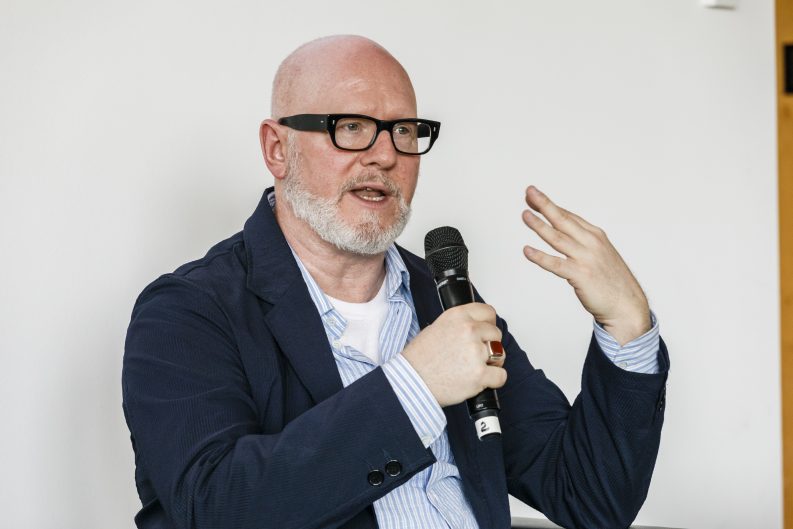

 David Saylor, Frankfurter Buchmesse 2023
© Copyright: Marc Jacquemin
By Erin L. Cox, Publisher | @erinlcox
‘A book is a perfect delivery system. It’s intimate, it’s something you get emotionally attached to.’
Over the last 20 years, the graphic novel market in the U.S. has grown exponentially. According to the industry publication ICv2, sales in 2005 were $250 million compared to figures for the 2024 the comic and graphic novel sales which soared to $1.935 billion, with graphic novels accounting for approximately 75% of those sales.In 2005, when David Saylor founded the graphic novel imprint Graphix at Scholastic to publish works for children, this future did not seem so clear. Though the graphic novel market was beginning to grow due to the successful film adaptations of V for Vendetta and Sin City which expanded the market to new readers, those stories were geared toward adults.
“When I started Graphix, there was no shelf space for graphic novels for kids – there was no such thing. There were middle-grade books, chapter books, and picture books, but there wasn’t a category in bookstores,” said Saylor. “And now, of course, they have their own section and they are very successful.”

 Image: Frankfurter Buchmesse
According to Saylor, one in every four middle grade books sold today is a graphic novel, with the market growing not only in the U.S., where Saylor is based, but around the world. He notes that there are other robust markets in France and Italy, growing markets in Spain, Germany, Finland, Sweden, and, of course, huge markets in Malaysia, Korea, and Japan.
Today, as Graphix celebrates its 20th anniversary, Saylor is now the Creative Director and SVP of Graphix at Scholastic. The company is centralizing all publishing art direction under Saylor’s leadership to highlight their investment in visual storytelling and further embracing the comic and graphic novel market.
Saylor notes that there is a lot of room for growth in the U.S. through more nonfiction graphic novels, manga, and world comics. He is always looking out for “the next person who is going to make kids laugh hysterically” or “really touch them.”
“In terms of the marketplace, the United States is still a little behind on some level,” said Saylor. “[That is likely due to] some prejudices about comics that still exist that educators and parents that didn’t grow up with them need to overcome,” referencing the 1954 Senate hearings which took comic books to trial for contributing to juvenile delinquency. But, those ideas are declining with parents today having grown up with graphic novels.
Though Saylor noted that only a small percentage of their list is acquired by foreign publishers, children around the world appear to be more open to “interesting stories that are worldwide,” citing the worldwide success Netflix has had with “K-Pop Demon Hunters.”
“With anime, it just sort of feels like we’re at this moment where there is more acceptance of different kinds of storytelling, or maybe even sort of a turning away from, say, traditional US storytelling,” said Saylor. Today, manga tends to be the more successful type of graphic novel to import/export, but the rights market for all graphic novels is growing.
 Graphix titles that have been successful abroad are Dav Pilkey’s Dog Man series, the 14th of which just came out in the U.S. in November. Dog Man been translated into almost 50 languages and, in 2024 with the 13th book, Graphix/Scholastic hosted a five-nation release date which Publishing Perspectives covered here.
Though reports note that there is a crisis in reading in the U.S., Saylor is optimistic about the future.
“A book is a perfect delivery system. It’s intimate, it’s something you get emotionally attached to. It’s something you love to collect; it’s something you love to own. When you give a kid their first book, or you see a kid at a book fair, picking up their book that they chose off the shelf, that joy can’t be replicated and it’s real,” said Saylor. “If you believe in that feeling, like I do, then I feel very positive about the future.”
As a publisher, Saylor wants to continue to provide great content to fuel that love of reading. “When you find an author and an artist and they really connect with their readers, that’s the most exciting feeling in the world.”