
By Erin L. Cox, Publisher | @erinlcox
A “small-but-mighty community”
Translators are the heart of the international publishing industry. They are often the first to read a story that could be brought to a new market, the sole voice advocating for a work to be published, and the steward of the original writer’s story, voice, and intention.In the last several years, questions have been raised about whether or not artificial intelligence will take the place of human translators, if the next generation of readers will be reading in their native language or reading books in English, or if markets, particularly the US in its current political state, will welcome stories from beyond its borders. All of these potential challenges ahead make the support of translators and their work and the building of community all the more important.

 Award-winning translator and workshop leader Liz Lauffer, Image Sabine Schwarz
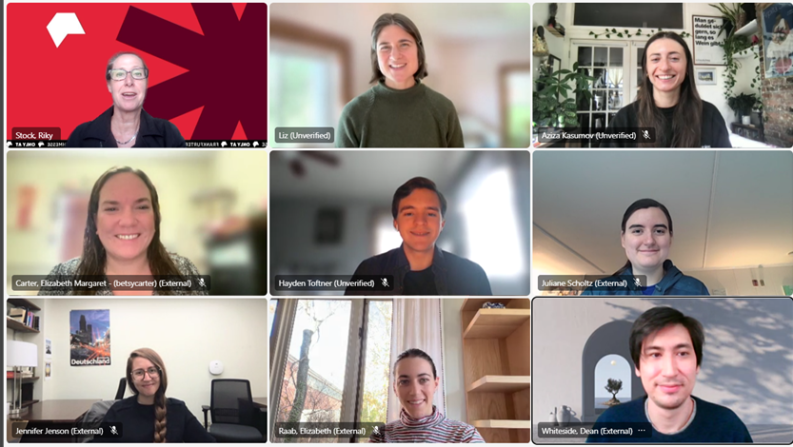
With that in mind, last month in New York City, the Goethe-Institut NYC and Frankfurter Buchmesse hosted a virtual translator workshop to provide community, education, and support for young German translators, hosted by acclaimed translator and winner of the 2014 Gutekunst Prize Liz Lauffer.
Rohan Kamicheril, senior editor at Farrar, Straus, and Giroux, founder of Tiffin and former editor at Words without Borders was a guest editor during the workshop to provide additional feedback and guidance to the translators.
Participants included Juliane Scholtz, Elizabeth Raab, Betsy Carter, Hayden Toftner, Jennifer Jenson, and Aziza Kasumov. Each of these translators had 8 weeks to translate an excerpt from Sara Gmuer’s Achtzehnter Stock, published in Germany by Hanser Verlag.
“I was eager to meet this merry band, discover how the next generation of literary translators is approaching our work, and dip into my own experience to see what I might pass on,” said Lauffer.
“They gave me a sense of belonging in this small-but-mighty community of ours. My hope is that this cohort will draw on the connections formed—whether it’s passing each other jobs, consulting on tricky bits, celebrating or commiserating with one another—and keep the flame lit.”
The translators submitted their translation samples two weeks before the workshop, on which Lauffer provided edits. Lauffer then chose an excerpt from each translation and shared those with Kamicheril who sent individual edits and comments back to each translator.

In preparation for the workshop, the translators were asked to each identify a paragraph they were struggling with. During the workshop, each participant shared what they found particularly challenging in the paragraphs they had chosen, which led to a lively exchange which highlighted the different perspectives and versions each could create.
Kamicheril stressed that there is right formulation because it is always about the bigger picture. What is the sound, the tone of the text? Which solution fits best in a particular context?
During the workshop, it became clear that the art of translation is closely tied to emotions, interactions, and interdependence, something AI cannot replicate.
“Though that’s been slowly changing, there’s just not a ton of infrastructure in the US to support emerging translators, so this was a rare opportunity to not only hone our skills but also learn more about the inner workings of the industry,” said Kasumov.
“I’m grateful to have been part of this group! My favorite part of the workshop itself was probably seeing how each and every one of us translated certain turns of phrases differently–a beautiful reminder that translation is an art, not something that can be automated away.”