

By Porter Anderson and Erin L. Cox
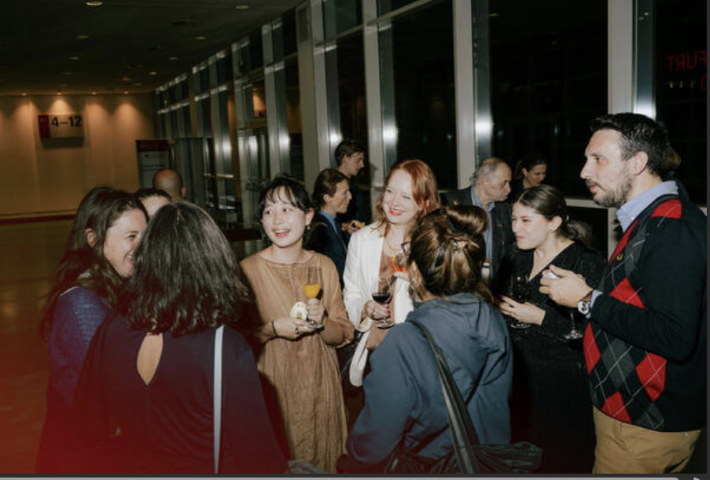
Earlier this year, the Frankfurt Fellowship and the Frankfurt Invitation Program merged into one new program called the Frankfurt Global Network. The program brings publishing professionals from around the world to Frankfurt and Zurich for visits to publishers and bookstores, market presentations, guided tours, matchmaking events, and numerous networking opportunities.Publishing Perspectives sat down with some of this year’s cohort to get to know them and hear more about their work and the publishing industry in their countries.
 Paula Erizanu, Moldova, Cartier Publishing House
 Paula Erizanu, Moldova, Cartier Publishing House
About her work: Cartier is a general publishing house founded in 1995 and based in Chisinau. We publish fiction, nonfiction, poetry, textbooks etc. We distribute across both Romania and Moldova and our authors are from both countries. We also publish translated fiction, especially from countries in the region. I have been managing rights, both selling and acquiring them, for Cartier since 2011.
About the market: 2025 has been a difficult year for the Romanian market because the VAT tax on books was raised to 11%, one of the highest rates in Europe. (In Moldova books are VAT exempt.) Also, Romania’s recent political instability and austerity measures, on top of the cost of living crisis, are affecting readers’ purchasing power. Romanian literature is still on its way to garnering more interest and a stronger international brand, although among our successes we can name EUPL winner Tatiana Țîbuleac, translated in 20 languages, Daniela Rațiu, whose rights were recently acquired by Grasset in France, Suhrkamp in Germany, Oleg Serebrian, translated into Polish and German and shortlisted for the Angelus prize. We do also hope that Moldova’s EU integration will enable us to cross borders unencumbered, including in order to deliver to the whole Romanian diaspora in Europe.
Camille Fesquet, France, Fayard
 Camille Fesquet, France, Fayard
About her work: I joined the foreign literature department at Fayard in April 2024 before starting to work mainly for Pauvert, an imprint that publishes French and translated literature, as well as literary non-fiction. Together with the literary director, Clément Braun-Villeneuve, we work alongside authors and translators to refine the texts so that they find their best possible final form. Over the past year, I have had the opportunity to participate in a new beginning for Pauvert, driven by a desire to recapture the irreverent spirit of the label’s early days. It came with many challenges: creating a new graphic identity, finding new voices and texts that offers both a high literary quality and themes that have not yet been explored extensively in literature.
About the market: When speaking with French publishers, both large and small, one gets the impression that 2025 has not been a very generous year so far. There is a certain amount of concern about the future. As everywhere else, I imagine, people talk a lot about how young people no longer read. However, I get the impression that, apart from specialized publishers, few literary publishing houses are really taking seriously the question of how to attract younger generations. I believe that this should not only involve increased activity on social media, but also a broadening of the themes that are highlighted and an effort to make room for young literary voices.
Szu-wei Fu, Japan, Tokuma Shoten
 Szu-wei Fu, Japan, Tokuma Shoten
About her work: I joined Tokuma Shoten last October. I am currently responsible for selling the rights to our books in international markets under my management (e.g., Chinese-, Spanish-, Portuguese-, German-, and English-speaking regions). Tokuma Shoten Publishing has established itself as a diverse publisher of literary works, business and sports books, comics, children’s books, magazines, and more. In recent years, it became part of the Culture Entertainment Group, further strengthening its presence in the entertainment industry. The group is now engaged in the planning, production, and distribution of films and videos based on original works.
About the market: While the number of bookstores is declining and sales of physical books are decreasing, there are still novels that have sold over one million copies. Some of these titles have gained popularity through tie-ins with movies and merchandise. Meanwhile, sales of e-books have been increasing, with many popular manga titles driving this growth. Additionally, audiobooks are still in their early stages in Japan. If audiobooks can become a part of people’s daily lives, I believe the number of people who read—or listen to—books will continue to grow. This year also seems to be a boom for Japanese literature in the international market–Butter has sold over 450,000 copies in the UK, The Night of Baba Yaga won the Dagger for Crime Fiction in Translation 2025, among others. I believe this momentum will continue to grow, and I hope international readers will explore the unique appeal of Japanese literature.
Roxanne Landry, Canada, La Mèche, Groupe d’édition la courte echelle
 Roxanne Landry, Canada, La Mèche, Groupe d’édition la courte echelle
About her work: Founded in 2010, La Mèche is a creative melting pot of bold, contemporary literature. La Mèche is an imprint of Groupe d’édition la courte echelle, alongside la courte echelle, first publishing house in Quebec to specialize in literature for young readers offering high-quality, unique and engaging books for to all age groups, and Parfum d’encre, creating relevant and inspiring nonfiction about society, family and lifestyle. I’ve been managing the rights of the three imprints for six years now. As Rights Manager, I promote our lists, negotiate rights deals (for translation, reproduction and adaptation rights) and develop our export plan related to rights licensing.
About the market: In 2025, there is a deceleration in our market of about 5% if we compare to last year. It is particularly noticeable in the institutional market and seems to be caused by important budget cuts from governments. Nevertheless, there are strong initiatives that promote books published in Quebec. There are multiple challenges for our company – the increases of the production cost of books. It is important for us to make books of high quality to an accessible price but it’s a hard thing to do; the status of the artist act’s reform which regulates artists in literature as it didn’t before, allowing an association of writers to negotiate collective agreements on behalf of their members; and AI. Recently there was a class action was launch against an IA developer.
Peter Michalik, Slovakia, Monokel
 Peter Michalik, Slovakia, Monokel
About his work: As the founder of what many see primarily as a children’s book publishing house, I often ask: Who decided that illustrated books are only for children? Under our motto “imagination at play,” our mission is both to nurture playfulness in children—and to bring it back to adults. As is often the case in a small independent publishing house, especially one from a small market, I wear many hats. Yet my role is perhaps closest to that of an art director, shaping the overall purpose, vision, and future development of the company. Because of the limited size of the Slovak-speaking market, we invested significant effort into building a network of international partnerships and developing part of our list with the prospect of licensing titles abroad. Our books are now available in 18 countries.
About the market: For its size, the Slovak market is surprisingly rich in output and varied in themes and styles. We see both original works and translations being brought to readers in an unprecedented way, and in this regard, 2025 does not appear to be exceptional. Last year, there was a political takeover of the Arts Council—a well-functioning support mechanism and a key driver of the remarkable publishing activity of recent years. We now watch closely to see how the appointment of politically motivated, unsuccessful applicants from the past to the Council’s board will influence the richness and quality of the publishing output.
Joakim Nørregaard, Denmark, People’s Press

 Joakim Nørregaard, Denmark, People’s Press
About his work: In 2022, I joined the editorial team at People’s Press and today I work as an acquiring editor. My main responsibility is to acquire and curate titles for our digital fiction list, but I also edit a selection of Danish authors and handle more literary translated titles. The publishing house was founded in 2002, and since 2017 it has been owned by Storytel, the Swedish audiobook and eBook streaming platform with a global presence. This also means that part of my job is to deliver content with strong streaming potential. Out of roughly 180 titles a year, around 100 are aimed directly at the streaming market – and not all of them are printed.
About the market: Denmark really is an increasingly digitalized book market and 29% of adults in Denmark now have access to a book streaming service, and about 24% pay for one. While the market is under pressure, we see signs of stabilization, though. After several years of decline, turnover grew again in 2024, mainly driven by print, while digital formats keep expanding.
Distribution is another pressure point. Fixed book prices were abolished in 2001, and since then supermarkets have become a key sales channel, while the number of booksellers has declined. In 2024, 43% of books were sold in book shops, 40% online and 17% in supermarkets (or elsewhere). The government has at least acknowledged the reading crisis. From 2026, the 25% VAT on books – one of the highest in the world – will supposedly be removed.
Noah Zacharias Schmitz, Germany, Suhrkamp
 Noah Zacharias Schmitz, Germany, Suhrkamp
About his work: For the past year I have been working as an editor for foreign fiction at Suhrkamp, as a maternity leave replacement – a very common way for young people to get a first serious job in publishing, at least in Germany. In this position I was commissioned to acquire English and French fiction for translation, as I already had been doing during my traineeship, but I also got the chance to really dive into the realm of Eastern European fiction, which was incredibly interesting.
About the market: There are of course the obvious challenges such as the decline in general reading, and then especially with regard to foreign fiction a stronger interest for national topics, accompanied by fewer possibilities to present international newcomers in the media or at events. And then there seems to be a general call for less literary and more escapist literature and the mix of genres (literary horror, literary gothic etc.) is also posing a challenge – but this is also an opportunity and a way to get creative as an editor. Overall, there have been some great successes and promising new publishing endeavours. At the same time, I feel like there is still growing amounts of pressure on individual titles, especially on titles, who don’t have an explicit commercial push. This leads to a weird situation where every book you acquire for a literary list needs to do the magic trick of being innovative and somewhat “safe” at the same time – that’s a hard one to pull off.
Yaroslava Udina, Ukraine, Artbooks
 Yaroslava Udina, Ukraine, Artbooks
About her work: Seven years ago, I started as a freelance proofreader at one of the largest Ukrainian children’s publishing houses. Two years ago, I joined the ARTBOOKS team, inspired by the titles they were bringing to Ukrainian readers. These were carefully chosen books whose visual design and meaningful content left no one indifferent. They were books that could genuinely touch people and help children grow into unique individuals — titles such as Bolivar by Sean Rubin, Hilda by Luke Pearson, The Invention of Hugo Cabret by Brian Selznick, Nightlights by Lorena Alvarez, etc. Today, however, it has become much harder to attract attention to children’s books in our country. ARTBOOKS is focusing more on adult projects and manga, which are crucial for keeping the business afloat. We take fewer risks with experimental formats and rely more on global bestsellers.
About the market: In today’s Ukraine, a book has become something of a luxury. Another enormous challenge is the shift to foreign-language books, driven by the mass departure of Ukrainian families abroad. Overall, the Ukrainian market is showing positive momentum in both new titles and print runs. According to the Ukrainian Book Institute, in the first half of 2025, the total number of books and illustrated editions published increased by 25% in the number of titles (7,131 compared with 5,714 last year) and by 37% in print runs (14.73 million compared with 10.78 million). Readers show the strongest demand for fantasy, romance, manga, and nonfiction about mental health and self-development.
For more information about the Frankfurt Global Network and to learn about all of this year’s participants, click here.
Comments
What is the purpose of the Frankfurt Global Network programme, and how does it support publishing professionals from around the world?