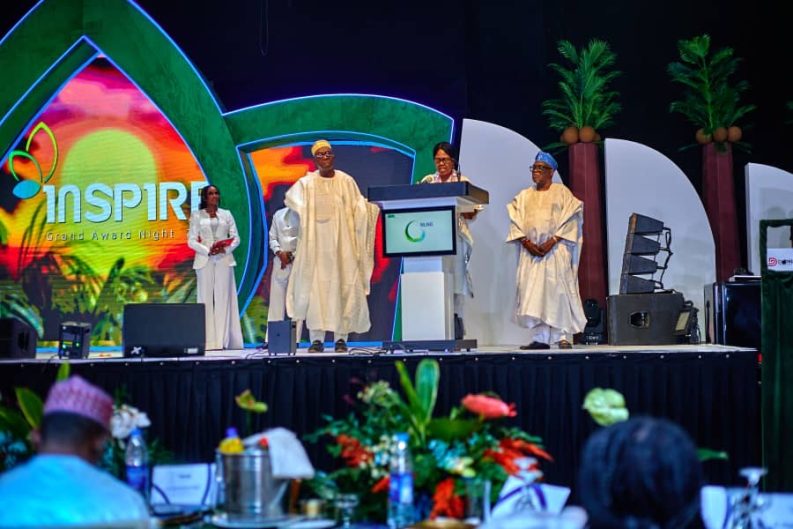

 Photo from 2025 Nigeria Literature Prize ceremony
By Faith Nwani
Literary prizes come and go. Others survive on reputation long after their relevance has thinned. The Nigeria Prize for Literature has achieved something rare: it has remained, evolved, and continued to shape the industry it was created to serve.In the Nigerian book industry, over the last two decades, new independent publishing houses have emerged, more writers are being published locally, and readership, particularly among young people, has continued to grow.
At the same time, publishers face rising production costs, developing distribution networks, and a readership increasingly affected by the high price of books. Editorial standards, once uneven, have improved; however, sustaining quality remains a challenge in an economy where producing books is expensive, and distribution remains challenging.
It was within this context that the Nigeria Prize for Literature was created. Established in 2004 by Nigeria Liquefied Natural Gas (NLNG), the Nigeria Prize for Literature was created to improve the quality of Nigerian writing, encourage excellent literature, and help Nigeria regain its strong literary reputation, and supports writers by giving recognition and prize money, each year focusing on a different genre – prose, poetry, drama, and children’s literature.

 Professor Akachi Adimora-Ezeigbo
Professor Akachi Adimora-Ezeigbo has engaged with the Nigeria Prize for Literature at every level. She first encountered it as a winner, later served as a judge, and became Chair of the Advisory Board in 2021.
The Advisory Board oversees the activities of the Prize, including the appointment of judges—selected for their expertise in the relevant genre. For the 2025 Prize, the judging panel included three Nigerian judges: Chair, Saeedat Bolajoko Aliyu, Prof. Stephen Mbanefo Ogene, Olakunle Kasumu and one international judge and consultant Dr. Grace Musila.
At its core, the Nigeria Prize for Literature was created to strengthen what Akachi repeatedly referred to as “the book chain” during our interview. By this, she means “everyone involved in the life of a book: writers, editors, publishers, printers, designers, marketers.” Literature, in this framing, is not produced by authors alone. It is the outcome of many skilled hands.
One of the most visible impacts of the Prize has been on quality. “Before, there were so many editorial errors. Many writers just asked their friends to read their work and went ahead to print.” Errors were common, and design wasn’t a priority.
That has changed.
According to Akachi, the Prize has helped reset expectations. “Today, most of these works are thoroughly edited; the quality of writing, editing, production and overall aesthetics has improved.” The reason is simple. “There is no way to win the Nigeria Prize for Literature without meeting a high standard across all these areas.”
This pressure to be recognized has had ripple effects across the Nigerian book industry. Independent and in-house editors are more valued. Publishers are more intentional about production, and writers are more deliberate about the journey from manuscript to finished book, and readers look forward to the winner each year.
The numbers reflect this shift. In 2025 alone, the Prize received over 250 submissions. Akachi spoke with clear pleasure, laughing lightly as she said, “The judges confessed that it was difficult to select the eleven longlisted titles, then the three shortlisted works and finally, a winner. It was tough.” Growth, however, comes with its challenges. While submissions have increased and reader interest has expanded, the affordability of books remains a serious concern.
Akachi expressed concern about the rising cost of books. “I wonder how the ordinary Nigerian can afford a ₦10,000 book, and buying books online can help, although I wonder how many people enjoy ebooks.”
Internationally, the value of the Prize continues to be a subject of discussion.

 Managing director of the Nigeria LNG Philip Mshelbila gives this year’s prize to winner Oyin Olugbile
“Readers from around the world are amazed at the size of the prize,” said Akachi. The amount (awarded in USD) is $100,000—roughly ₦145 million depending on exchange rates—remains one of the most significant literary awards internationally. This observation has surfaced repeatedly in conversations at international literary events and industry gatherings, as well as in discussions around the Prize’s global standing. The Prize’s credibility rests not only on its monetary value, but on its consistent process and track record.
Recent winners include:
- 2025 – Sanya (Prose) by Oyin Olugbile
- 2024 – The Road Does Not End (Children Literature) by Olubunmi Familoni
- 2023 – Grit (Drama) by Obari Gomba
- 2022 – Nomad (Poetry) by Romeo Oriogun
- 2021 – The Son of the House (Prose) by Cheluchi Onyemelukwe-Onuobia
The Prize was not awarded in 2020, due to the global pandemic.
The Nigeria Prize for Literature operates on a genre rotation—drama, prose, poetry, and children literature. With this cycle, 2026 is expected to be a poetry year.
This structure has helped sustain diversity in Nigerian writing, rather than pushing authors toward a single dominant form.
According to Akachi, the influence of the Prize does not end with the winner. “Several past recipients have gone on to establish their own literary initiatives. For example, 2012 winner Chika Unigwe set up the Awele Creative Trust Prize for young writers in Nigeria.”
The Nigeria Prize for Literature itself supports longlisted and shortlisted writers through structured activities. Longlisted authors participate in book parties and signings; these sessions bring writers directly into contact with readers, with shortlisted authors receiving further exposure through media appearances, and copies of their books distributed to students and readers.
2025 Winner, Oyin Olugbile, has clearly stated the impact of the prize on her career. Beyond smiling to the bank, she also had this to say, “Winning the 2025 Nigeria Prize for Literature has been truly transformative. It has amplified the visibility of my work, opened doors to global literary networks, and deepened interest in African mythology and storytelling, which is at the heart of what I write. Beyond the professional milestones, the win has affirmed the power of stories rooted in culture and community, and it has encouraged me to continue writing boldly and expansively.”
Another pillar of the Prize is its process. “The Prize is organised in such a way that there is transparency from the submission level. Everything is taken seriously as NLNG wants the integrity of the prize to be taken seriously. There is no bias, as every entry is judged based on its merit.”
Over the years, NLNG has convened stakeholders across the book industry to reflect on how the Prize can improve. Akachi noted, “NLNG is a listening company. It was during one of the stakeholders’ meetings that the Advisory Board was established to strengthen the Prize.” The goal, she explained, is continuity, a system that can evolve without losing credibility.
The 2025 submissions reflected both established and emerging publishers. “Houses like Cassava Republic Press, Masobe Books and Narrative Landscape Press, to mention a few.” Masobe Books ultimately published the winning title in 2025.
There are also signs of expansion. Akachi hinted at a forthcoming prize for creative arts, focused on film and filmmakers, expected to be unveiled in 2026. “The future of the Nigeria Prize for Literature and creatives is very bright,” Akachi said simply. “As far as we know, we don’t plan on stopping.”
In an industry where sustainability is uncertain, the Nigeria Prize for Literature’s commitment matters. With submissions for 2026 expected to open soon, it continues to play a steady role in shaping Nigerian writing and publishing.
Comments
Subject: A Proposal for Literary Partnership and Nigerian Publication**
Dear Faith Nwani,
I hope this message meets you in strength and creative fullness. Your work with **Book Drive Africa**, your commitment to nurturing a reading culture among young people, and your contributions to the African literary ecosystem continue to inspire many of us who believe in the transformative power of stories. Your editorial experience — from *Ma Kẹkẹ* to Narrative Landscape Press — and your presence on *The Writer’s Sauce Podcast* reflect a rare blend of vision, craft, and community-minded leadership.
My name is **Onyedikachi Nmezi**, a Nigerian-born novelist and advocate for literature as a tool of empowerment. I am reaching out to explore a possible collaboration with you on two of my completed novels:
– **_Chikoba_**
– **_Umuofia and the Things Left Unsaid_**
Both works engage deeply with identity, memory, community, and the quiet but powerful tensions that shape our lives. They are written with the intention of contributing meaningfully to contemporary Nigerian literature while remaining accessible to young readers, emerging thinkers, and the wider public.
Given your passion for expanding access to books across Africa and your editorial expertise, I would be honored to have you **project these works within your networks** and, if it aligns with your vision, **take charge of their publication or republication in Nigeria**. Your guidance — whether through editorial direction, publishing coordination, or strategic visibility — would bring immense value to this mission.
I believe these novels can serve not only as literary contributions but also as resources for the young readers and communities you continue to uplift through Book Drive Africa.
If this resonates with you, I would be grateful for the opportunity to share the manuscripts and discuss possible pathways forward.
Thank you for your time, your work, and your unwavering commitment to African storytelling.
Warm regards,
**Onyedikachi Uzozie Nmezi**
Owings Mills, Baltimore Maryland USA
I loved how this piece sheds light on the Nigeria Prize for Literature not just as a prize, but as a catalyst for strengthening the whole “book chain” — from writers to editors to designers — and raising both quality and interest in Nigerian publishing. It’s inspiring to see how literary recognition can ripple outward to elevate production and readership alike. Do you think initiatives like this could make books more affordable and accessible for everyday readers in Nigeria?