
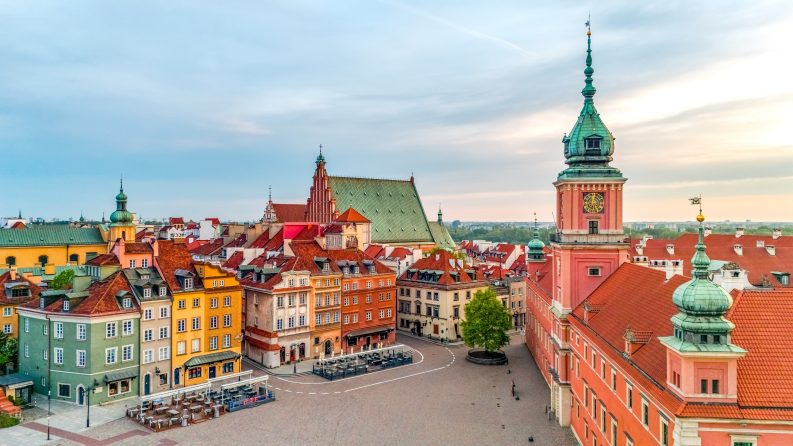

 Castle Square, Warsaw
By Jaroslaw Adamowski
Poland’s Ministry of Culture and National Heritage has announced it is launching legislative work on a bill with measures designed to protect the country’s book market. The draft bill will incorporate the recommendations of the Book Market Roundtable which accommodated representatives of Polish publishers. Among others, the legislation is to fix a price for books for 12 months.In a statement, the ministry said that, once it is finalized, the draft bill will be submitted for consultations with other ministries in early December 2025.
“The initial assumptions of the bill were consulted with representatives of numerous creative communities, including during the Book Market Round Table workshop, debates at the Poznań and Gdańsk Book Fairs, and the Reading Has Only Good Sides conference, which concluded the second edition of the National Reading Development Program,” the statement said.
Under the plan, the legislative proposal will introduce three major changes to the country’s publishing market:
- Enforcing fixed book prices for 12 months for each new title introduced to the market, preventing major retailers from offering new releases with major discounts that could put small bookstores at disadvantage;
- Capping maximum wholesale discounts at 45 percent and banning distributors from collecting additional fees from publishers;
- Imposing mandatory sales data reporting by publishers, importers and retailers to the state-run Statistics Poland agency that will then make these figures available to publishing houses, creators and other persons involved in the publishing process.

 Anna Nasiłowska, a writer, professor at the Institute of Literary Research of the Polish Academy of Sciences, and the president of the Polish Writers’ Association (SPP). Photo by Mikołaj Rek
Anna Nasiłowska is a writer, a professor at the Institute of Literary Research of the Polish Academy of Sciences, as well as the president of the Polish Writers’ Association, Stowarzyszenie Pisarzy Polskich (SPP).
Nasiłowska told Publishing Perspectives that, in Poland, writers have long expected legislative changes that would introduce more transparency and accountability to the system, providing creators with more economic stability.
“In Poland, success for a poet could mean selling 500 copies of their book, and for novelists selling between 3,000 and 10,000 copies is quite a success. Authors collect around ten to 12 percent of the wholesale price of a book. And the wholesale price is 50 percent of the price of a book at a bookstore,” she said.
The latest legislative development comes following years of lobbying by the country’s publishers and authors. More than four years ago, the Polish Chamber of Books (Polska Izba Książki, PIK) kicked off consultations on a draft bill to introduce fixed book pricing to the market. At that time, speaking to Publishing Perspectives, Włodzimierz Albin, a board member of the chamber, said that the legislative proposal was “not related to fiscal issues, but it introduces some changes to the rules that apply to the publishing market. It isn’t a novelty in Europe, as the majority of major European countries have implemented such rules that apply to books, and these countries represent more than 60 percent of the European Union’s population.”
Under Poland’s political system, once drafted by the Culture Ministry and consulted with other ministries, the legislative proposal will need to be adopted by the country’s government, and subsequently sent to the Polish parliament for further legislative work. If the parliament approves the draft bill in a vote, it will be sent to the country’s president for his signature.
Should the proposed legislation enter into force, Poland could join a growing number of European states that have implemented fixed book prices. In a report, the Monopolies Commission, an independent advisory body to Germany’s government, said that 14 countries in Europe have fixed such prices for retail.
“The most important countries with fixed retail prices, as measured by annual sales, are Germany, France, Italy and Spain. Due to the competition concerns of the European Commission against industry agreements, many countries, including Germany in 2002, have adopted a legally binding fixed book price system,” according to the report. “A book price law has existed in Spain since 1975 and in France since 1981.”